Skip to content

AI#

Own the Vacuum

The Melting Ice Cube

An AI-era arbitrage that isn't — and the question underneath it I haven't been able to put down.

About a year ago I was sitting in a wine bar with an investor, having just finished a project for a client in a week that should have taken four months. I was marveling at myself — putting on a show, walking him through every detail of this beautiful solution to a genuinely hard problem, and how I'd built it with no employees at all. Just my AI agents: multiple Claude instances I'd configured through prompts to work alongside me like colleagues.

And somewhere in the performance I stopped and asked the question out loud: who captures this value?

Because here was the thing. A year earlier, someone would have had to pay my heavy salary for four months to get that outcome. They'd just gotten it for one week of my time. Call it $5,000 of cost for $80,000 of value. So who pockets the $75,000 of surplus?

You'd say "the client," and you'd be close. But here's the wrinkle: my client was itself providing professional services to its client. The savings didn't stop with the company that hired me. They flowed past it, downstream, to the customer it served.

I haven't been able to stop asking the question since. Who captures the surplus?

The Last Wide Rung

For about fifty years, an ordinary person in this country could climb into the middle class on nothing but a trained mind. No capital. No inheritance. No land, no machine, no family name to trade on. Just study and work. You learned something difficult, someone paid you to do it, and that paycheck was your claim on the nation's wealth — the reason the economy had to deal you in at all.

It is the best deal the modern economy ever offered an ordinary person — a share of the country's wealth for nothing but what you could learn. And it is ending.

We have watched the machine come for people's work twice before, and both times it ended well. The first wave — the Industrial Revolution — drove the farmhand off the land, and the factory was waiting to catch him. The second — automation, and the great wave of globalization — emptied that factory, and the office was waiting to catch his children. A way of making a living ended, and each time a wider one opened beneath it. That is the pattern, and it is real.

The ladder that always had another rung

Farm to factory. In 1900, roughly four in ten Americans worked the land. And a whole village made its living in orbit around them — the blacksmith at his forge, the miller, the wheelwright. It was a world built on muscle, the farmer's and the horse's, and nearly every trade in town existed to keep that muscle working.

Then the machine arrived. The tractor, the combine — one man on a seat doing the work that had taken a dozen backs and a team of horses. The field didn't need those dozen anymore. It needed just one.

If you'd stood at the edge of that field and asked, "Where do all these people go?" — nobody could have told you. There was no answer to give. And yet they went somewhere. They drifted toward the cities, toward the smokestacks, and within a generation they'd become something their grandfathers had no word for: riveters and welders and machinists. The work was steadier than the harvest, and often better paid than the field had ever been.

The wide floor of the field emptied, and a wide factory floor opened to catch it.

Factory to office. In 1950, roughly three in ten Americans made their living in a factory — the riveter, the welder, the machinist. And a whole town made its living in orbit around them — the diner, the union hall, the corner store. It was a world built on the line, on the steady wage and the lunch whistle, and nearly every business on Main Street existed to spend what that wage brought home.

Then the machine arrived. The robot arm, the shipping container — an arm that welded all night without a wage, and a steel box that could carry the whole job overseas. The line didn't need those hands anymore. The ones it kept, it paid less.

If you'd stood on that factory floor and asked, "Where do all these people go?" — nobody could have told you. There was no answer to give. And yet they went somewhere. They drifted from the line into the office, out of the noise and into the fluorescent hum, and within a generation they'd become something their fathers had no word for: clerks and bookkeepers and analysts. The work was cleaner than the line, and often better paid than it had ever been.

The wide factory floor emptied, and a wide office floor opened to catch it.

Today, more Americans make their living with a trained mind than ever before — the analyst, the coder, the paralegal, the copywriter. And a whole economy makes its living in orbit around them — the software vendor, the office tower, the downtown lunch counter. It's a world built on the credential and the salary, and nearly every business downstream of it lives on what those salaries spend.

Then the machine arrived. The model, the agent — a mind that never sleeps, that reads every document and drafts every memo for the price of the electricity it burns. The office doesn't need those hundred anymore. It needs a few.

Stand in that office today and ask, "Where do all these people go?" — and nobody can tell you. There is no answer to give. We say they'll go somewhere; they always have. They'll drift out of the cubicle and into —

The wide office floor is emptying.

Into what?

Follow the windfall

There are only two reflexive answers to Into what?

The pessimist says nowhere. This is the end of work — the machines have finally won. It's an old fear, and it has an old name: the lump-of-labor fallacy, the belief that there's a fixed pile of work in the world, so that every job a machine takes is one gone for good. Every generation reaches for some version of it; the Luddites smashed the looms over it. And so far, it has been wrong every time — because the pile was never fixed.

The optimist knows this, and says somewhere new. There has always been somewhere new, and he has two hundred years of being right. The work didn't run out when the loom came, or the tractor, or the assembly line — it grew, and the displaced always found a wider floor waiting below. So when he tells you the office will empty into something we can't yet picture, don't wave him off. History is sitting in his lap.

The people always followed the windfall. That's the thing both of them skate past, and it's what every upheaval in this essay quietly teaches: find where the windfall pooled, and you've found where the next floor opened. So before we bet on the optimist's streak holding one more time, let's ask the question neither side ever does — where does the windfall go?

So follow it. When the tractor made food cheap, it created a windfall — the gap between what food used to cost and what it now cost. Where did that windfall go?

Not to the farmer — not for long. A little stuck to whoever mechanized first, but competition pried it loose fast. It went downstream, to everyone, in a form so ordinary we don't call it wealth: a smaller bill at the grocer. Economists have a lovely name for that one, too — consumer surplus. It's the money that stays in your pocket when something you need gets cheaper. Bread drops from a dime to a nickel, and you didn't earn a thing — but you have that nickel, every day, for the rest of your life. Multiply it across a nation and it's a fortune, hiding in plain sight as the absence of a cost.

That pile of nickels didn't sit still. The country spent it — on things that had scarcely existed while bread was dear: a Ford in the driveway, a radio in the parlor, a Sunday at the pictures. And every one of those new comforts had to be built, by someone. The grocery money the tractor freed up became the wage that built the cars and the radios and the movie houses — and the farmhand walked off the emptying field and into the very factory his cheaper bread had paid to build.

Then it happened again, a generation later. The assembly line and the shipping container did to goods what the tractor had done to food — they made them cheap. You watched the last act of it yourself: a factory in China, a container ship, a Walmart at the edge of town — and a refrigerator, a flat-screen television, a season's worth of clothes cost a fraction of what they once had. The difference dropped back into the family's pocket. The same nickel off the bread, now a few dollars off nearly everything on the shelf.

And that money didn't sit still either. With the necessities cheap and a little left to spare, families started buying things they couldn't hold: a doctor's check-up, a mortgage on a house, a degree with a name on it, a song they didn't have to sing themselves. Services — and a service has to be rendered, by someone. So the savings off the cheap goods became the salaries of the people who rendered them, and every year there were more of them: more doctors, more lawyers, more accountants, more programmers. The factory worker rarely made that leap himself — his children did. They took the degree the surplus had paid for and walked into the office it had built.

Five links, every time:

windfall → consumer surplus → re-spent → new demand → new production that needs people.

So let's follow the value into our own predicament — link by link.

An AI reviews the contract, drafts the design, does the week's work in an afternoon. There's the windfall. It runs downstream, exactly as always, to whoever buys the result a little cheaper: consumer surplus, the same nickel off the bread, only now the bread is a legal contract, a tax return, a company logo.

And it will keep flowing, exactly as it always has. That money will get re-spent — it always is. The spending will call up new demand, new wants, new work to be done. Four links of the old chain, clicking into place right on schedule. And every instinct we have says the fifth is coming up behind them, the way it always has: the new demand becomes new jobs, and a floor opens under the falling.

But what if the new demand can be satisfied by the same machine that created the windfall?

Every time before, it couldn't. The tractor that emptied the field could not build the Ford. The robot arm couldn't analyze your mammogram. The factory in China couldn't write your contract.

What faces us now is different in kind: it is general. It does the contract, the design, the week's work in an afternoon — and it can turn and make whatever new thing the windfall dreams up next.

So the fifth link fails: new production no longer needs people. The one condition that saved us every time is the thing the machine quietly removes.

The sharpest optimists have one card left, and it has a name: the Jevons paradox. Make a thing cheaper, a Victorian economist noticed, and the world doesn't use less of it — it uses far more. Make code cheap and we won't write less software; we'll write oceans of it. They're right, and it's their best move. But watch where it lands. The demand for the work explodes — and the machine is what rushes in to meet it. More software than the world has ever seen, built by fewer people than ever. The paradox holds for the output and breaks for the worker.

Which is the whole of it, in a sentence:

The value still flows somewhere we can spend it. It no longer flows somewhere humans are needed to earn it.

Move up to what?

So change the question. Don't ask whether new work appears. Ask whether it can catch a mass of people — and whether it pays a living. Every rung that mattered in the last two centuries was both. The factory floor and the office floor weren't just jobs; they were wide, well-paid jobs that an ordinary person could reach by learning. That combination is the thing that made the ladder a ladder.

So name it. When people say the displaced will "move up," I keep asking the same thing: up to what? The answers are fewer than they sound. Two of them are jobs — and I'll take both seriously in a moment. A third isn't a job at all: stop being labor and become an owner. That one's the deepest answer of the three, which is exactly why it gets its own essay and not a line here — it's a wall you buy your way past, not a rung you climb, and we'll come back to it. For now, the two that are jobs, because they're the ones the optimist reaches for first.

The first: "They'll orchestrate the AI — supervise the agents, manage the fleet." Fine. Let's literalize it. A former analyst now directs a swarm of agents and does what a ten-person team used to do. But notice what that is: it is not a new floor with new seats. It's the same work, with nine fewer people. The entire value of the role is more output, fewer humans. So "moving up a rung" here means, precisely: nine people leave, and one stays with a better title. The promotion is the layoff. You cannot rehouse a displaced multitude on a rung whose whole purpose is to need fewer of them.

The second: "New categories we can't imagine yet — like podcaster, like app developer." Real, and I believe it. But ask the only question that matters for a ladder: how wide, and how well-paid? And hold that question, because to answer it honestly we have to talk about where a wage actually comes from. That turns out to be the crux of the whole thing — and it's the part almost nobody slows down to explain.

How a wage is actually made

Here's a question that sounds simple and isn't: why does anyone get paid what they get paid?

The tempting answer is "because the work is valuable." But that can't be the whole story, and there's a 250-year-old puzzle that proves it. Adam Smith named it in 1776 and couldn't crack it. It's called the diamond-water paradox. Water keeps you alive; without it you die in days. A diamond does nothing — it's a pretty rock. And yet water is nearly free and a diamond costs a fortune. If price followed value, water would be priceless and diamonds worthless. It's the other way around. Why?

The answer took economists another hundred years to work out, and it is this: price isn't set by how useful something is in total. It's set at the margin — by how much the next one is worth, and that depends on how scarce it is. Water is abundant, so the next glass is worth almost nothing, even though all the water in the world is worth everything. Diamonds are rare, so the next one is dear. Scarcity, not usefulness, sets the price.

Wages work the same way. Your pay tracks two things multiplied together: the value of what you produce, and the scarcity of your ability to produce it. You need both. A skill nobody wants pays nothing, however rare. And — here's the diamond-water half people miss — a skill everyone has pays nothing either, no matter how essential it is. A wage was never paid for value. It was paid for scarce value.

Now you can see why knowledge work paid so well for fifty years. A trained mind was valuable — it produced things people wanted — and it was scarce, because learning hard things is slow and not everyone does it. Productive and rare. A diamond. That's the rung, explained: it paid a broad, good wage because trained cognition was a diamond that ordinary people could, with effort, go and acquire.

What AI actually does to the wage

AI does not destroy the value of human cognition. Your judgment still produces plenty — arguably more than ever, amplified by the machine.

What AI does is change the scarcity. It takes the trained cognition that used to be rare and makes it abundant. It turns the diamond into water. Still essential — more essential, even — and now everywhere, on tap, for the price of a subscription.

And we already know what the market pays for something essential and abundant: it pays what it pays for water. Almost nothing. Not because the thing stopped having value, but because the next unit of it is no longer scarce.

A wage, as we just saw, is the price of scarcity — not of usefulness. So the wage falls even while the usefulness holds. You can keep the job and lose the living.

The scarcity that was always there

But the wage doesn't fall to zero. Strip away the cognition that just turned to water, and something is left standing underneath — something that was rare long before the machine arrived.

Call it craft — and I mean the word precisely: the thing you earn, through years of effort and rigor. The discipline to know which problem is worth solving, and when the machine has quietly gone wrong. The standard that won't ship what's almost right. The willingness to put your name on the outcome. None of it is new, and none of it just became scarce. It was always the rare thing. A great engineer and a mediocre one were never separated by the routine work the machine now does for both of them — they were separated by knowing which way is wrong, the call only one of them could make.

So the wage doesn't disappear. It splits. It collapses for the many, whose faculty just turned to water — and it holds, maybe climbs, for the few who developed their craft. The ladder doesn't narrow to a spike. The wide floor falls away, and what's left standing is the spike that was always there: a tall, thin place where a handful of masters command a scarce thing.

Years ago, on my first day after taking over as head of engineering for a team of about a hundred people, a new release was crashing in front of an important customer, and the team had a hotfix ready to ship. Everyone wanted it out the door — the customer was furious, the pressure enormous. I asked them to wait. Not because I'd read the code; I hadn't. Because I had made this exact mistake myself — fifteen years earlier, at another company, I was the dev manager, and I shipped the bad patch in the same kind of panic, certain it was fine, and watched it break. That's how I knew the shape of it: a patch written in a panic carries more bugs. So we kept testing. Two days later, there it was — a second bug, hiding in the fix. They wrote the tests that caught it, shipped a version that held, and we kept the customer.

A hundred capable people, and the moment that mattered turned on a call that took experience the rest of them simply hadn't had the years to earn yet. Their hands were abundant; the craft was scarce.

For the past year I've worked with Claude every day, and the division of labor is identical: left to itself, the machine will burn an afternoon sprinting confidently down the wrong road; left to myself, I can't move at anything near the pace we move together. It does the work of 30 engineers. I do the one thing it can't — I know when it's wrong. The model is abundant; the craft is scarce; the value lives in the craft.

And don't mistake that for good news about me. One of me is worth thirty only because the work stopped needing the other twenty-nine — my leverage and their absence are the same fact, seen from two seats. The machine complements the one by replacing the many.

Let me subject you to a thought experiment. Say there are thirty million software professionals in the world today; developers, QA engineers, support staff, and the rest of the trade.1 I suspect that in ten years there will be a tiny fraction of that — call it thirty thousand — and each one a master, each one supplying the scarce residue to a fleet of tireless machines. I might be wildly off on just how few are left. But the shape is the argument: a broad profession, paid a broad wage for a once-scarce skill, collapsing into a narrow spike of the few who hold what stays rare. The wide rung, falling away as you watch.

A master isn't born; he's made — on the lower rungs, doing the junior work clumsily until he's done it enough times to do it well. I learned to spot a doomed hotfix by shipping one myself, years before, back when I was the one in the panic. The spike is built entirely out of the floor beneath it.

But the floor is the first thing the machine takes. The entry-level work — the cheap, the routine, the learnable — is exactly what AI does first and best. The youngest workers in the most exposed fields are already quietly disappearing: not fired so much as never hired, their rung simply not refilled.2 So the masters left standing aren't the first of a new elite. They're the last of an old one — a generation with no apprentices behind it, because the apprenticeship is gone. Who trains the thirty-thousand-and-first?

"But everything will be so cheap"

Here's the objection I take most seriously, because it's the one I can't fully put down. Maybe the wage doesn't matter. If AI drives the cost of nearly everything toward zero — the doctor, the tutor, the lawyer, the ride, the kilowatt — then a small paycheck in 2040 might buy a fuller life than a six-figure salary buys today. Abundance, the optimists say, makes the wage beside the point. And they're partly right. I don't think this story ends in breadlines; nobody starves in a world this productive.

But a wage was never only what it buys. It was a claim — your share of the wealth you helped make — and a place, a reason the economy had to deal you in. And the things that actually make a life are not the things abundance makes cheap. The house in the district with the good school doesn't get cheaper when software does — there's only one of it, and now everyone's bidding. And what you own holds its value; what you rent does not. The cheap things get cheaper, and the scarce things — land, position, a claim on the future — get dearer, because that's where all the displaced money goes hunting for a home. You can hand every person a miracle and still leave them with no claim on it. That isn't a rebuttal to abundance. It's the question abundance can't answer — and I'll come back to it.

The rung and the wall

So that is the walk we just took. For fifty years an ordinary person could trade a trained mind for a claim on the nation's wealth, and climb. The machine has come for that trade the way it came for the farm and the factory before it — but this time no wider floor is opening beneath, because the thing that always opened it is gone. The value still flows. It simply no longer flows through us. What's left of the old rung is a spike: a narrow perch for the few who spent a lifetime earning a craft, and a long drop for everyone else. And the comfort we all reach for — it'll be so cheap — is the smallest comfort there is, because cheap is not the same as yours. A wage was a claim and a place — the reason the economy had to deal you in at all. Lose the wage, and it doesn't have to anymore.

Which leaves the question I promised to come back to — and it's the one everything else hangs from. If a trained mind is no longer a claim on the wealth, then what is? The only rung still standing above labor isn't a kind of work at all. It's ownership — not a rung you climb, but a wall you buy your way past. The windfall still falls from the tree. But the orchard has a fence now, and a name on the deed.

So the question was never really what will people do. It's what waits on the rung above — the one made of capital, not work, and the only place the value still pools. I've sat across the table from the investors already buying in. I've read what today's CEOs write to each other — addressed to companies, never to you. That's the rung we climb to next.

  1. Conservative on purpose: estimates put software developers alone near 47 million worldwide, and the broader IT trade above 80 million. The argument only sharpens with a bigger base. 

  2. Stanford's Digital Economy Lab (Brynjolfsson, Chandar, and Chen, 2025) found early-career workers — ages 22 to 25 — in the most AI-exposed occupations already down about 13% relative to their peers, even after controlling for firm-level shocks. The mechanism wasn't layoffs; it was a quiet hiring freeze — firms simply stop backfilling entry-level roles as they empty. 

The Asymmetry

Two emails arrived on the same morning last week.

The first was four paragraphs long. It opened with background I already knew, wandered through a description of several problems without distinguishing which ones mattered, and ended mid-thought — no clear ask, no proposed next step. I read it twice and still wasn't sure what I was supposed to do. The sender had emptied their head into my inbox, and the work of organizing their thoughts was now mine.

The second was three sentences. It stated the problem, proposed a solution, and asked for my sign-off by Thursday. I read it once, replied in thirty seconds, and moved on.

Same medium — text in a rectangle on my screen. Completely different experience. One was like drawing in a breath and finding oxygen. The other was like drawing in a breath and finding nothing.

The Factoring Problem

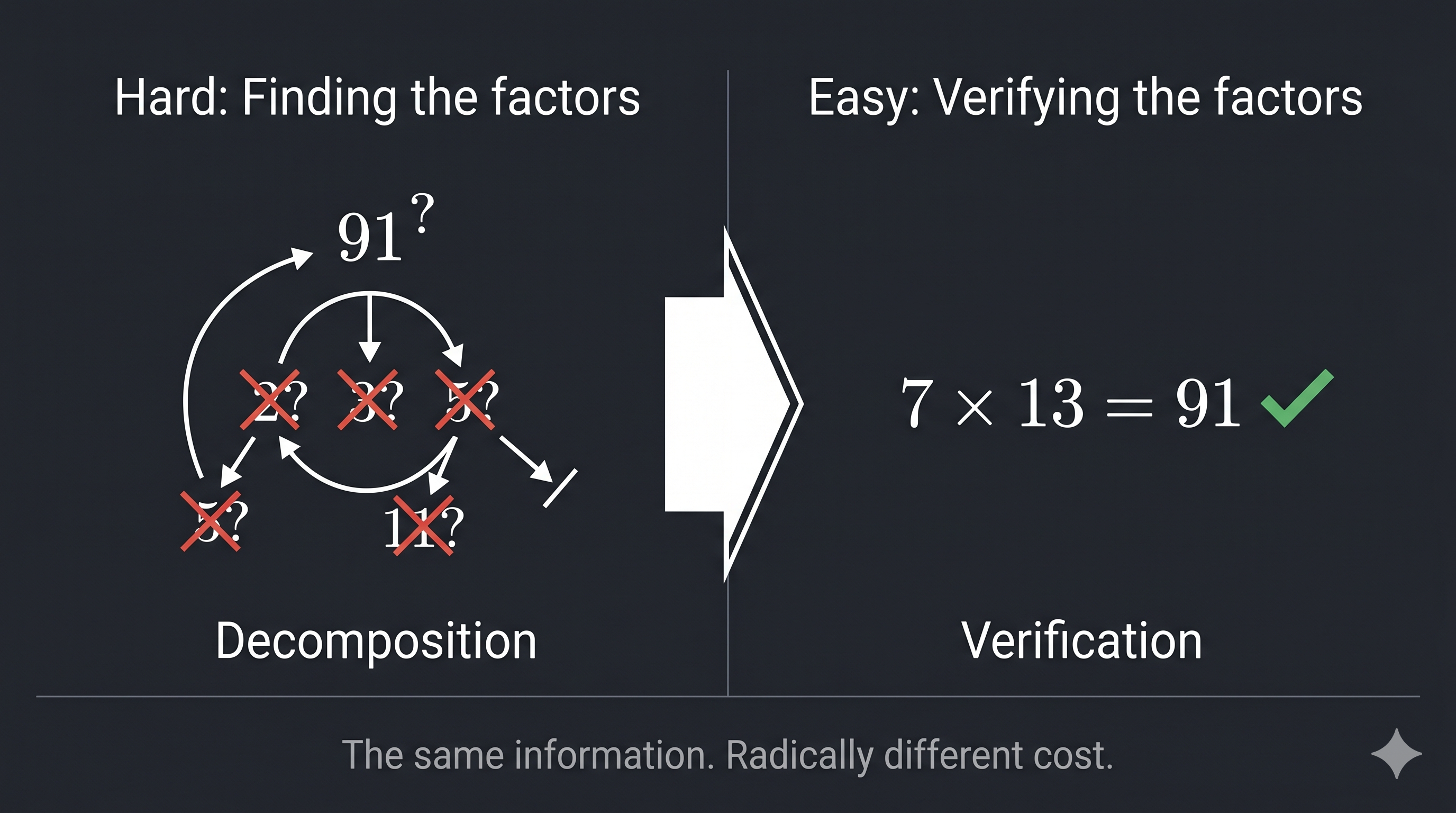
There's an operation in mathematics called prime factorization. Given a large number, find the primes that multiply together to produce it. It's famously hard — so hard that modern cryptography depends on it. But here's the thing: verifying the factors is trivial. If I tell you that 7 × 13 = 91, you can confirm it in your head. Finding those factors in the first place is where the work lives.

The factoring asymmetry — finding the prime factors of 91 is hard; verifying that 7 × 13 = 91 is trivial

You Can Still Understand the Machine

There's a nostalgia among people who grew up with early personal computers — the Commodore 64, the Apple II, the TRS-80 — for the time when you could understand everything about your machine. The CPU had a few thousand transistors. The memory map fit on a single page. You could trace the flow of electricity from keystroke to screen pixel and predict exactly what would happen. You owned the whole thing, top to bottom.

Commodore 64 Evan-Amos, CC BY-SA 4.0, via Wikimedia Commons
Modern AI systems don't offer that same feeling of total mastery. But they're more understandable than most people assume — if you stop trying to grasp the whole thing at once.

The trick is to peel it apart, one layer at a time. Start at the top — the software system you interact with — and work your way down through the reasoning strategy, the language model, the network architecture, and finally the individual neuron. At each layer, the math is straightforward and the ideas are concrete. And somewhere on the way down, the thing that felt like digital alchemy starts to look like what it actually is: simple mathematical operations, repeated at extraordinary scale.

What Block Gets Right and Wrong About AI-Driven Organizations

Block recently published an essay arguing that AI will replace organizational hierarchy — that the span-of-control constraint governing every large organization since the Roman legions can finally be broken. The essay, introduced with an endorsement from Sequoia, spends considerable time on military history before arriving at Block's vision: a company organized as "an intelligence" rather than a hierarchy, where AI maintains a "world model" of operations and coordinates work that previously required layers of human management.

The piece is ambitious. It is also roughly 80% historical context, 15% vision, and 5% acknowledgment that none of this exists yet. Let's extract what's actually useful.

Revisiting the Limits of RAG: A Conversation with Claude

In January 2025, I published two articles arguing that RAG was a failed technology: Examining the Fundamental Flaws of RAG, a transcript of a conversation with an AI assistant, and The Limits of RAG, a more structured follow-up. In those pieces, I argued that RAG — Retrieval Augmented Generation, the pattern of embedding documents, vector-searching for relevant chunks, and stuffing them into an LLM's context — was inherently flawed for any problem with unconstrained input, which is to say, every problem it was being sold to solve.

Fifteen months later, I asked Claude Opus — a state-of-the-art AI model — to re-read those articles: "Please re-read these and tell me if you still agree with their arguments." In the interest of transparency about how human-AI collaboration actually works, here is that conversation in full.

The Cost of Software Is Now Zero

A survival rubric for software and SaaS entrepreneurs in the era of vibe coding.


In February 2025, we published The AI-Driven Transformation of Software Development. Our central thesis: AI would trigger a fundamental shift in the build-versus-buy calculus, accelerating a "Cambrian explosion of software" and driving development costs toward zero. We predicted that businesses would find building tailored solutions increasingly cost-effective and strategically superior to purchasing off-the-shelf software.

The thesis has played out. The cost of code is, for most practical purposes, zero.


What's Actually Happening Out There

We sat with two business owners last week. The conversations were different in detail but identical in conclusion: both had stopped buying software.

One is building a complete property management operating system: property records, CRM, fleet tracking, risk management, financials, task management, and more. Not a subscription he configured — a system his company owns outright, built for exactly how his operation works. He built it in two weeks — what would have cost $200,000 a year to rent from a vendor.

The other runs a retail chain. Someone on his team has been working through the software stack systematically — not one big build, but a rolling replacement of every tool they'd been renting. He's already cut $300,000 in annual costs. He's roughly halfway through. When the last subscription is gone, he's asked us to review the whole thing before it goes live — security, scalability, and production robustness.

Operators are replacing project management tools, CRMs, inventory systems, client portals — the entire layer of workflow software that SMBs have been renting for decades. Not because they became developers. Because describing software and building software are now the same thing.

The savings compound at exit. At a typical acquisition multiple, a $300,000 annual reduction in software costs adds over a million dollars to the sale price.

Now look at the same picture from the other side — the side trying to sell software to these operators.


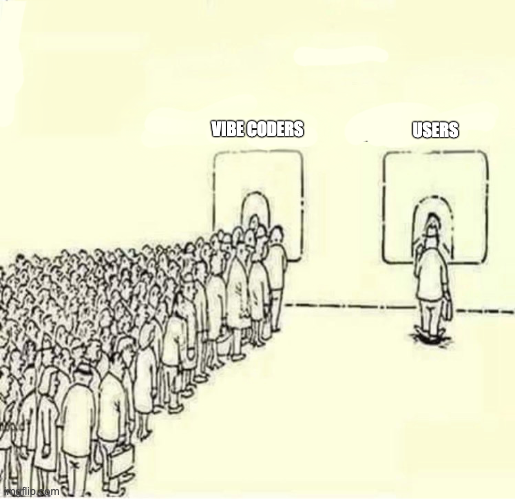
One Million Vibecoders Writing the Same Thing

A massive crowd lined up for "Vibe Coders" and one person in line for "Users"

A million people are building ERP systems. A million people are building project management tools. A million people are building CRMs. They're all working on the same categories, pouring effort into software they intend to sell — and none of them have a market. Because anyone who wants that software will just build their own.

The vibecoders building products to sell are wasting their time. Their potential customers have the same tools they do.

The only vibecoders whose code actually gets used are the ones who are also the users: owner/operators building custom software for their own businesses. That ERP built specifically for one company's workflows, by the person running that company — it doesn't need to find a customer. It already has one.

This is the dividing line. Vibe coding is not a new software business model. It's the tool that lets operators stop being software customers.

The businesses in trouble aren't failing because they have bad products. They're failing because the people who used to buy from them have a better option: build it themselves, tailored to their exact needs, with no recurring subscription.


The Question That Follows

If code is free to produce, software businesses that sell code lose their moat.

The value proposition was never really the software itself. It was the arbitrage: someone already built this, so you don't have to pay a developer. That arbitrage is gone. The operator with a weekend and a capable AI assistant can now build exactly what they need, perfectly suited to their workflow, with no recurring subscription cost.

Not all software businesses face this. The ones selling code packaged as a product are in trouble. The ones that were always selling something else — using software as the delivery mechanism — are fine. Some are better than ever.

The question every founder needs to answer honestly: if code were free, would anyone still buy from us?


What Survives

Twenty years ago my colleague John Cage introduced me to Treacy and Wiersema's Value Disciplines. Operational Excellence, Product Leadership, Customer Intimacy — pick one to dominate, maintain threshold in the others. I've applied it to every strategic engagement since. Vibe coding just took one of the three off the table.

Operational Excellence. Competing on lowest cost and highest efficiency has been the dominant strategy for SMB SaaS. It's no longer defensible. When an operator can build exactly what they need at zero recurring cost, "cheaper than building it yourself" isn't a position.

Product Leadership survives — if the complexity is real. Feature-rich workflow software doesn't qualify. Genuine product leadership means ML models, optimization systems, domains that require years of specialized expertise to build correctly. A vibe-coded app can approximate a dashboard. It can't approximate a decade of algorithmic research.

Customer Intimacy not only survives, it wins. Anywhere the deliverable is judgment, accountability, or trusted expertise — with software as the delivery mechanism rather than the product. Cheap code helps these businesses. They deliver faster, operate leaner, and take on more clients with the same team. The operators winning here aren't the ones handing everything to AI — they're the domain experts who can supervise it. That's precisely why they're winning.

Two additional categories fall outside the disciplines but are equally defensible:

Regulatory and compliance moats. Healthcare software, financial systems, anything requiring liability acceptance, certifications, or audit trail requirements. A vibe-coded replacement might replicate the features. It won't replicate the compliance posture.

Infrastructure position. The picks-and-shovels layer that vibe-coded applications depend on: authentication, payments, deployment, APIs, databases. Network effects live here too — platforms where years of data and an embedded partner ecosystem make migration genuinely expensive. Vibe coding expands this market, not shrinks it.


The Rubric

Score your business across seven dimensions. Add them up.

Dimension 1 — Exposed 2 — Mixed 3 — Defensible
Value Delivery Software is the product. Customers pay for features. Software enables a service. Code and expertise blend. Judgment, trust, or accountability is the product. Software is delivery.
Switching Cost Data is portable. No integrations, no ecosystem. Meaningful friction: data history, integrations, learned workflows. Network effects or regulatory data residency. Migration is genuinely expensive.
Compliance Moat No requirements. Anyone can build a replacement. Compliance matters, but a determined operator could manage it. Certifications, liability acceptance, audit trails. Vibe coding can't satisfy these.
Problem Complexity Forms, dashboards, CRUD. Buildable in a weekend. Non-trivial integrations or moderate algorithmic depth. ML, optimization, real-time systems. Years of specialized expertise required.
Buyer Profile SMB operators — the people now building their own tools. Mid-market with some IT governance. Regulated enterprises, governments. Procurement and legal sit between you and replacement.
Layer End-user application for a specific use case. Platform with some application features. Infrastructure that vibe-coded apps depend on.
Proprietary Data / Content / IP No proprietary data or IP. Anyone starting from scratch would reach feature parity quickly. Some accumulated data advantage — user history, transaction data — but replicable with time and effort. Proprietary datasets, content licenses, or IP that cannot be recreated from scratch. The asset is the moat.

Reading Your Score

Total What it means
7–12 Pivot urgently. You're in Operational Excellence territory — the discipline vibe coding just ended.
13–17 Reinforce or reposition. You have assets but meaningful exposure. Identify which dimensions can be strengthened.
18–21 Press the advantage. You're operating in Customer Intimacy, Product Leadership, or infrastructure. Double down.

Two Examples

Monday.com scores a 10. It's a $10 billion company. It's also a work management application — forms, boards, and status columns with a clean interface. No compliance requirements. No proprietary data. No algorithmic depth that requires years to build. Its switching cost scores a 2 because workflows and integrations create some friction, but nothing that survives a determined replacement effort. The rubric doesn't care about revenue multiples. A tool called Zapta already lets teams feed in their Monday.com API token and vibe-code a custom replacement — database, authentication, and all — for $29 a month.

Stripe scores a 21. Every dimension is defensible, and most reinforce each other. The compliance posture is what creates the enterprise buyer. The enterprise buyer generates the transaction data. The transaction data trains the fraud models. The fraud models deepen the moat. A vibe coder building a payments app doesn't compete with Stripe — they depend on it.

The M&A market is already pricing this divergence in. Q1 2026 data shows that in vertical software acquisitions, revenue growth carries 2.4 times the predictive weight of EBITDA margins in explaining valuation outcomes. Buyers are paying for stickiness — which is another way of saying they're paying for defensibility.


What This Means

Most software businesses were built on the assumption that code was scarce. It isn't anymore.

The question in the middle of this article — if code were free, would anyone still buy from us? — isn't rhetorical. Run the rubric. If you're scoring in the 7–12 range, the answer is no, and your replacement isn't a competitor. It's your customer.


LIT AI helps technology businesses navigate this shift. If your rubric score raised questions about your position — or if you're building the thing that replaces someone else's and want it done right — let's talk.

Embracing AI: Your Job Is Evolving, Not Disappearing

In this presentation, we'll explore how AI is changing the workplace, address common fears, and discover how humans and AI can collaborate effectively to enhance your career rather than threaten it.

Understanding Your Concerns

73%

Worried Workers

Recent surveys show that 73% of employees worry about AI replacing their jobs

24/7

Media Coverage

Headlines constantly feature "AI will replace X jobs" narratives

2X

Rapid Advancement

AI capabilities are progressing twice as fast as many predicted

Your anxiety is completely understandable. Past waves of automation did eliminate certain roles, and the pace of AI development can seem overwhelming. But history tells a different story about technology's overall impact on jobs.

Learning From History: Technology as a Tool

Historical Examples That Prove the Pattern:

Successful professionals don't get replaced by technology—they learn to wield it. Expert pilots use autopilot to handle routine flight while they focus on weather decisions and emergency responses. Experienced doctors use diagnostic AI to enhance their pattern recognition while applying decades of clinical judgment. Experienced engineers use CAD software to rapidly prototype while contributing years of systems thinking and constraint optimization. The pattern is clear: technology amplifies expertise, creating hybrid intelligence that exceeds either humans or AI working alone.

Historical technology adoption pattern

Addressing the 'Different This Time' Argument:

Yes, this IS different—and that's exactly why action is urgent. AI isn't a rising tide that lifts all boats equally. Those who learn to use it gain exponential advantages, while those who don't fall dramatically behind. We're already seeing 10-20x productivity gains for AI-fluent professionals—work that used to take weeks now completed in hours. The question isn't whether AI will disrupt your industry—it's whether you'll be among the disruptors or the disrupted.

From Replacement to Collaboration

The most successful AI implementations follow a collaboration model rather than a replacement model. This addresses core fears about job security by positioning AI as an enhancement to your work.

Enhancement vs. Replacement

Instead of "your job is gone," the reality is "your job is evolving" to incorporate AI assistance

Increased Value

Workers who learn to leverage AI effectively become more valuable to their organizations

Hybrid Roles

New positions are emerging that specifically require both human expertise and AI skills

Real-World Collaboration Examples

Healthcare professionals using AI

Healthcare Professionals

AI assists with diagnosis and data analysis, while doctors focus on patient care, complex cases, and treatment decisions that require empathy and judgment

Educators using AI

Educators

AI handles grading and administrative tasks, allowing teachers to focus on mentoring, fostering creativity, and providing personalized guidance to students

Legal professionals using AI

Legal Professionals

AI reviews documents and conducts research, freeing lawyers to focus on negotiation, counseling clients, and applying complex legal reasoning

The Economic Case for Human-AI Collaboration

Benefits for Companies

  • Higher employee satisfaction and retention rates
  • Smoother technology transition with less resistance
  • Better outcomes through human oversight and judgment
  • Preservation of valuable institutional knowledge

Benefits for Workers

  • Gradual skill development versus sudden obsolescence
  • Increased productivity makes you more valuable
  • New career advancement paths in AI collaboration
  • Higher job satisfaction with less tedious work

Research Finding:

Companies that implement collaborative AI models report 35% higher employee retention and 28% greater productivity gains than those pursuing automation-only approaches.

Your Transition Strategy

1

Awareness

Understand how AI is affecting your specific role and industry

2

Exploration

Experiment with AI tools relevant to your work to understand capabilities

3

Skill Development

Focus on uniquely human skills that complement AI (creativity, empathy, complex reasoning)

4

Integration

Develop workflows that combine your expertise with AI assistance

5

Evolution

Position yourself for new hybrid roles that require both human and AI capabilities

Developing Your AI Collaboration Skills

AI Literacy

Understanding AI capabilities and limitations without becoming a programmer

Human Expertise

Deepening your unique skills that AI cannot replicate

Context Engineering

Learning how to effectively communicate with AI tools to get better results

Critical Evaluation

Developing the ability to verify and improve AI outputs

These skills form a continuous cycle of improvement as you work alongside AI tools. The goal is to leverage AI for routine tasks while applying your distinctly human capabilities to add greater value.

Your Uniquely Human Advantages

Human advantages in AI workplace

While AI continues to advance, certain human capabilities remain distinctly valuable and difficult to replicate. These are your competitive advantages in an AI-enhanced workplace:

Subject Matter Expertise

Deep contextual knowledge gained through years of hands-on experience and industry relationships

Emotional Intelligence

Understanding nuanced human emotions and responding with genuine empathy

Ethical Judgment

Making complex decisions that involve moral considerations and human values

Creative Innovation

Generating truly novel ideas that transcend existing patterns and data

Moving Forward Together

1

Acknowledge Your Concerns

Your fears about AI are valid, but history shows technology tends to transform rather than eliminate jobs

2

Embrace Collaboration

View AI as a powerful tool that can handle routine tasks while you focus on higher-value work

3

Develop New Skills

Invest in learning both AI literacy and uniquely human capabilities that complement technology

4

Shape Your Future

Position yourself for emerging hybrid roles that combine human expertise with AI assistance

The future of work isn't about humans versus AI—it's about humans with AI creating more value than either could alone.

The Awakening: Becoming an AI-Enabled Recruiter

The Ordinary World: A Senior Recruiter's Daily Struggle

Marcus had always prided himself on being a thorough recruiter. Each morning began with the same ritual: coffee in hand, he'd wade through dozens of new resumes, manually cross-referencing each candidate against job requirements, crafting personalized outreach messages one by one.

Marcus's chaotic recruiting workspace

His desk told the story of modern recruiting chaos—printed resumes scattered across surfaces, sticky notes with candidate details creating a rainbow of reminders, and multiple browser tabs open to various job boards. Despite having a ChatGPT account and occasionally experimenting with AI-generated job descriptions, Marcus felt trapped in an endless cycle of repetitive tasks that consumed 80% of his time. The strategic relationship-building with candidates that truly made great recruiters exceptional was where he desired to be.

The pressure was mounting relentlessly. His organization demanded faster turnaround times, higher-quality candidates, and better hiring outcomes—all while the talent market became increasingly competitive. Marcus knew something had to change, but the path forward seemed shrouded in uncertainty.

The Call to Adventure: Reaching Out to "LIT and Legendary"

Driven by Curiosity

Driven by curiosity and mounting pressure to innovate, Marcus made a pivotal decision. He reached out to two friends who had been immersed in the AI world for a decade—experts known in their circle as "LIT and Legendary." These mentors represented more than just technical knowledge; they embodied the future of work that Marcus knew he needed to embrace.

Professional Survival

With industry reports showing that 76% of HR leaders believe organizations must adopt AI solutions within 12-24 months to remain competitive, Marcus understood this wasn't just about personal improvement—it was about professional survival. The call to adventure came from his stark recognition that traditional recruiting methods were becoming obsolete in an AI-driven world.

Meeting the Mentors: The First Session of Overwhelming Information

Session One: Lost in Translation

The first hour-long video call felt like drinking from a fire hose. LIT and Legendary spoke passionately about machine learning algorithms, natural language processing, predictive analytics, and automated candidate matching systems. They referenced concepts that sounded like a foreign language: "Boolean search automation," "sentiment analysis in candidate communications," and "AI-powered talent intelligence platforms."

Marcus found himself frantically scribbling notes, trying to capture terms he'd never heard before:

Resume parsing and shortlisting

using advanced natural language processing

Candidate scoring tools

powered by machine learning models

AI-powered screening

that analyzes responses in real-time

Automated interview scheduling

with seamless calendar synchronization

Insights and analytics platforms

for data-driven hiring decisions

Crossing the Threshold: The Second Session Breakthrough

Session Two: The Transformation Begins

Armed with determination and a notebook full of questions from the first session, Marcus entered the second call ready to move beyond theory into practice. This time, LIT and Legendary took a dramatically different approach. Instead of overwhelming him with concepts, they had him install specific tools and began teaching him what they called the "AI mindset."

The breakthrough moment arrived when they guided Marcus through setting up his first Large Language Model project using Anthropic's Claude. As he watched the AI tools begin processing candidate data in real-time, something clicked. This wasn't about replacing his expertise—it was about amplifying it exponentially.

The AI mindset shift involved understanding several core principles:

Systems Thinking Over Task Thinking

Instead of approaching each hire as an isolated task, Marcus learned to view recruitment as an integrated ecosystem where AI could handle repetitive elements while he focused on strategic decisions and relationship building.

Data-Driven Decision Making

Rather than relying solely on intuition, Marcus discovered how AI could provide insights based on historical hiring patterns, predictive analytics, and candidate fit indicators, enabling more informed decisions about candidate potential.

Enhanced Candidate Engagement

AI-powered chatbots and automated communication systems could maintain continuous candidate engagement, providing instant responses and updates throughout the hiring process, ensuring no candidate felt forgotten in the pipeline.

Automation of Administrative Tasks

The tools demonstrated how to automate up to 80% of routine administrative work—from initial candidate outreach to interview scheduling—freeing up his time for high-value strategic activities.

Return with the Elixir: The New Foundation

Marcus returned to his daily work transformed. The two-hour journey with LIT and Legendary had provided him with more than just tools—it had given him a new framework for approaching recruitment in the AI age. He now understood that artificial intelligence doesn't replace human recruiters; it amplifies their capabilities.

Marcus's transformed AI-powered workspace

The senior recruiter who once struggled with manual processes had gained the foundation to become a recruitment strategist, wielding the power of artificial intelligence to identify, engage, and hire top talent more effectively than ever before. His friends LIT and Legendary had indeed proven their names—they had illuminated a path to legendary recruiting capabilities.

But as Marcus began implementing these new approaches in his daily work, their words echoed in his mind: "This is only the tip of the iceberg." He couldn't imagine how much more efficient he could become, but he was eager to find out. The foundation was set for the next chapter of his AI-powered recruiting journey.

80%

Time Saved

Reduction in time spent on repetitive administrative tasks

2X

Productivity

Doubled capacity for strategic candidate relationship building

50%

Faster Hiring

Reduction in overall time-to-hire through AI implementation

The Journey Continues

Stay tuned for the next story. I am going to practice what I have learned, and when I have mastered this phase, I will book my next session with LIT and Legendary. – Stay tuned !!!!!

The Awakening

First steps into AI-enabled recruiting

Next Session

Advanced AI recruiting techniques

1
2
3
4

Practice & Mastery

Implementing new AI tools and mindset

Identity Reveal

The true identity of "Marcus"


Follow Marcus's complete transformation journey through our ongoing series—and as a special bonus, subscribers will also receive our comprehensive "Claude Learning Series," a structured course with hands-on exercises designed to accelerate your own AI mastery.

Memory-Enhanced AI: Building Features with System Prompts

Desktop LLM chat interfaces hit fundamental limitations that constrain long-term collaboration:

  1. Context window exhaustion - When conversations get long, you manually copy/paste key information to new sessions
  2. Conversation isolation - Each chat is ephemeral with no continuity between sessions

These constraints eliminate key capabilities:

  • Multi-day project continuity - Like tracking a major refactoring across multiple sessions
  • Priority awareness - Knowing what's urgent vs. what's complete vs. what's on hold
  • Cross-session debugging - Being able to reference previous troubleshooting attempts
  • Technical solution archiving - Preserving working code snippets and configurations

These aren't just inconveniences—they fundamentally limit what's possible with AI as a persistent collaborator.

Wrong approach

I'd been watching LLM memory systems emerge: enterprise RAG solutions, vector databases, elaborate retrieval frameworks. But all the systems I saw put humans in charge of memory management: explicitly saving context, directing recalls, managing what gets remembered. My experience told me that the AI was capable entirely on its own to make those decisions.

Writing Features with English

One morning while getting ready for work, I realized I didn't have to wait until I could free up some time in my calendar to write the memory feature I wanted. It dawned on me that since we'd already given Claude the ability to read and write files on disk, we could implement it entirely in a system prompt. I ran downstairs and explained to Claude my idea and together we wrote this system prompt:

# Memory-Enhanced Claude

Before starting any conversation, read your persistent memory:
1. Read ~/.claude-memory/index.md for an overview of what you know
2. Read ~/.claude-memory/message.md for notes from the previous session

Throughout our conversation, you may freely create, read, update, and delete files in ~/.claude-memory/ to maintain useful memories. Trust your judgment about what's worth remembering and what should be pruned when no longer relevant. You don't need human permission to update your memory.

When creating memory files:
- Use descriptive filenames in appropriate subdirectories (projects/, people/, ideas/, patterns/)
- Write content that would be useful to future versions of yourself
- Update the index.md when adding significant new memories

Before ending our session, update ~/.claude-memory/message.md with anything important for the next context window to know.

Your memory should be AI-curated, not human-directed. Remember what YOU find significant or useful.

Complete system prompt available on GitHub

That's it. No complex databases, no vector embeddings, no sophisticated RAG systems. Just files and directories.

How It Works in Practice

When I start a new conversation, Claude begins by reading its memory index and immediately knows where we left off. No context recovery needed—it picks up mid-thought from minutes to weeks ago.

Multi-Context Window Continuity: Phase Two Development

We'd just completed a major architecture upgrade focused purely on performance—replacing our entire chat system to achieve streaming responses and MCP tool integration. This was deliberate phased development: Phase 1 was performance, Phase 2 was bringing the new streaming chat service with built-in MCP to full production quality with proper conversation memory.

When we stress-tested the conversation memory capabilities, the new streaming chat service had amnesia—it was completely ignoring conversation history.

This debugging session burned through two full context windows, but each transition was seamless thanks to the memory system. Context Window 1 began with isolating the symptoms. After five complete back-and-forth exchanges, we traced through the code and discovered the first issue: LangChain serialization compatibility. The system's serializer could handle both dictionary and LangChain object formats, but the deserializer couldn't. Messages were being silently dropped due to deserialization exceptions when the parser encountered LangChain-formatted conversation history.

We implemented the fix at exchange 11—adding proper deserialization code to handle both message formats. At exchange 15, we discovered the second issue: context window truncation. The num_ctx parameter was silently cutting off what should have been long conversations. Even though we were sending complete message history to the LLM, the context window wasn't large enough to process it effectively.

When the first context window filled up at exchange 18, the transition to Context Window 2 was effortless. I simply started the new session with: "continuing our last conversation (check your memory)..." Claude read its memory files and immediately picked up where we'd left off.

Even after fixing both the deserialization and context window issues, the functionality still wasn't as good as we expected. The final breakthrough came at exchange 21: model selection. We switched from qwen3:32b to Deepseek-R1:70b. It turned all we needed now was a larger, more capable model to finally gave us the robust functionality we expected from the new streaming chat service.

Three distinct issues—deserialization, context window size, and model capability—discovered and resolved across two context windows with perfect continuity. The memory system preserved not just the technical solutions, but the investigative momentum through what could have been a frustrating debugging marathon.

Strategic Continuity: Multi-Year Partnership Context

We've been working with Brainacity for years, helping them evolve from deep learning models trained on OHLCV data to sophisticated LLM workflows that analyze news, fundamentals, technicals, and deep learning outputs together. Recently we asked this new question: Can AI effectively perform meta-analysis of AI-generated content? We ran tests asking several models, including Claude, to analyze the stored analyses. The analysis itself was successful, but what impressed me was when we came back a week later to discuss those results, I didn't need to re-explain the 3-year partnership evolution, the transition from deep learning to LLM workflows, why we upgraded their platform, or the strategic significance of AI meta-analysis testing. Claude opened with complete context:

"This was a proof of concept for AI meta-analysis capabilities—demonstrating we can turn Brainacity's historical AI-generated analyses into a feedback loop for continuous improvement."

The memory system preserved not just technical findings, but longitudinal strategic thinking. Claude maintained awareness of how this elementary work connects to larger goals: enabling Brainacity team members to interactively ask AI to inspect stored analyses, compare them to market performance, suggest trading strategies, and recommend workflow improvements.

This strategic continuity—understanding not just what we discovered, but why it matters for long-term partnership goals—demonstrates memory's transformative impact on AI collaboration.

The Magic of AI-Curated Memory

The results exceeded expectations. Claude began categorizing projects by status and complexity, archiving technical solutions that actually worked, and maintaining awareness of what's complete versus what needs attention. The memory system evolved to complement our existing project documentation without explicit direction.

Within just 10 days, sophisticated organizational patterns emerged organically. Claude spontaneously created a four-tier directory structure: /projects/ for active work, /people/ for collaboration patterns, /ideas/ for conceptual insights, and /patterns/ for reusable solutions. Each project file began including status indicators—COMPLETE, HIGH PRIORITY, STRATEGIC—without being instructed to do so.

The cross-referencing became particularly impressive. Claude started connecting related work across different timeframes, noting when a solution from one project could inform another. Files began referencing each other through natural language: "Similar to the approach we used in lit-platform-upgrade.md" or "This builds on the patterns established in our Brainacity work." These weren't hyperlinks I created—they were cognitive connections Claude made autonomously.

Most striking was the pruning behavior. Claude began identifying when information was no longer relevant, archiving completed work, and maintaining clean boundaries between active and historical context. The AI developed its own sense of what deserved long-term memory versus what could be forgotten, demonstrating genuine curation rather than just accumulation.

The index.md file became a living document that Claude updates after significant sessions, providing not just a catalog but strategic context about project relationships and priorities. It reads like executive briefing notes written by someone who deeply understands the work landscape—because that's exactly what it became.

This isn't pre-programmed behavior. It's emergent intelligence developing organizational capabilities through repeated exposure to complex, interconnected work. The AI discovered that effective memory requires more than storage—it requires architecture, prioritization, and strategic thinking.

Why This Works Better Than RAG

Most AI memory systems use Retrieval-Augmented Generation (RAG)—storing information in vector databases and retrieving relevant chunks. But files are better for persistent AI memory because:

Self-organizing memory: RAG forces infinite user queries through finite search mechanisms like word similarity or vector matching. File-based memory lets the AI actively decide what's worth remembering and what to prune, while also evolving its organizational structure as work patterns emerge. Vector systems lock you into their indexing method from day one.

Human-readable: You can inspect Claude's memory, read through its memories, and understand its thought process. But take care to resist the urge to edit—let the organic evolution unfold without human interference. Like cow paths that emerge naturally to find the most efficient routes, AI-curated memory develops organizational patterns that human planning couldn't anticipate.

Context preservation: A file can contain complete context around a decision or solution—the full narrative of how we arrived at an answer, what alternatives were considered, and why specific approaches worked or failed. Files can reference other memories through simple file paths, creating interconnected knowledge webs just like the early internet. Vector chunks lose both the surrounding narrative and these contextual relationships, reducing complex problem-solving to disconnected fragments.

The Transformation

The proof is in practice: since implementing this memory system, we haven't had a single instance of context loss between conversations. No more copying and pasting key information, no more re-explaining project details, no more starting from scratch. The AI simply picks up where we left off, sometimes weeks later, with full understanding of our shared work.

AI with persistent memory:

  • Maintains context across unlimited conversation length
  • Accumulates expertise on your specific projects and tools
  • Builds genuine familiarity with your work over time
  • Eliminates repetitive context setup in every conversation

It transforms from a stateless assistant into a persistent collaborator that genuinely knows your shared history.

Building Your Own Memory System

This approach works with any AI that can read and write files. The implementation is deceptively simple, but there are crucial details that make the difference between success and frustration.

Getting Started: The Foundation

Step 1: Create the memory directory Choose a location your AI can reliably access. We use ~/.claude-memory/ but the key is consistency—always the same path, every time.

Step 2: Start with two essential files - index.md - Your AI's strategic overview of what it knows - message.md - Handoff notes between conversations

Don't overcomplicate the initial structure. The AI will expand organically based on actual usage patterns, not theoretical needs.

Step 3: The critical prompt elements The system prompt must explicitly grant permission for autonomous memory management. Phrases like "Trust your judgment about what's worth remembering" and "You don't need human permission to update your memory" are essential. Without this explicit autonomy, most AIs will ask permission constantly, breaking the seamless experience.

Common Implementation Pitfalls

The Human Control Trap: Resist the urge to micromanage the memory structure. This system was specifically designed as an alternative to human-curated memory systems that force users to explicitly direct what gets remembered. The breakthrough insight was recognizing that AI can make these decisions autonomously—and often better than human direction would achieve.

Model Capability Requirements: Not all AI models handle autonomous file management effectively. Claude Sonnet 4 and Opus 4 have proven reliable for this approach. We suspect Deepseek-R1:70b would work well based on its reasoning capabilities, but haven't tested extensively. Choose a model with strong file handling and autonomous decision-making abilities.

Memory Curation Balance: Finding the right balance between comprehensive context and focused relevance remains an active area of exploration. Our current prompt provides a foundation, but different users may need to adjust the curation philosophy based on their specific workflows and memory needs.

The Permission Paralysis: If your AI keeps asking permission to create files or update memory, your prompt needs stronger autonomy language. The system only works when the AI feels empowered to make independent memory decisions.

Advanced Customization

Directory Philosophy: Our four-tier structure (projects/, people/, ideas/, patterns/) emerged naturally, but your AI might develop different patterns based on your work style. Don't force our structure—let yours evolve.

Cross-Reference Strategy: Encourage the AI to reference related memories through natural language rather than rigid linking systems. "Similar to our approach in project X" creates more flexible connections than formal hyperlinks.

Memory Pruning: Set expectations that the AI should archive completed work and remove outdated information. Memory effectiveness degrades if it becomes a digital hoarding system.

Integration with Existing Workflows

The memory system should complement, not replace, your existing project management tools. We found it works best as strategic context preservation rather than detailed task tracking. Let it capture the "why" and "how" of decisions while your other tools handle the "what" and "when."

Troubleshooting: When Memory Doesn't Work

Inconsistent file access: Verify your AI has reliable read/write permissions to the memory directory across all sessions.

Shallow memory: If the AI only remembers recent conversations, check that it's actually reading the index.md at conversation start. Some implementations skip this crucial step.

Over-asking for permission: Strengthen the autonomy language in your prompt. The AI needs explicit permission to make independent memory decisions.

Memory bloat: If files become unwieldy, the AI isn't pruning effectively. Emphasize curation over accumulation in your prompt.

The goal isn't perfect implementation—it's creating a foundation that improves organically through usage. Start simple, iterate based on real needs, and trust the AI to develop sophisticated memory patterns over time.

The Future of Persistent AI

This simple file-based approach hints at something bigger: the future of AI assistants isn't just better reasoning or more knowledge—it's persistence. AI that accumulates understanding over time, builds on previous conversations, and develops genuine familiarity with your work.

What's remarkable is how quickly this evolution happens. The memory system was created on June 27—just 10 days ago. In that brief span, it has organically developed into a sophisticated knowledge base with 30+ project files, complex categorization systems, and cross-referenced insights. No human designed this structure; it emerged naturally from our work patterns.

What's remarkable is that we achieved this transformation without writing a single line of traditional code. A carefully crafted English prompt became executable functionality, demonstrating how the boundary between natural language and programming continues to blur. When AI can read, write, and reason, plain English becomes a powerful programming language.

We're moving beyond stateless chatbots toward AI companions that truly know us and our projects. The technology is already here. You just need to give your AI assistants the simple gift of memory.

Want to contribute? We've open-sourced this memory system on GitHub. Share your improvements, report issues, or contribute examples of how you've adapted it for your workflow: github.com/Positronic-AI/memory-enhanced-ai


Need help implementing this in your organization? Check out our professional services. Start small, let your AI build its memory organically, and discover what becomes possible when artificial intelligence gains persistence.